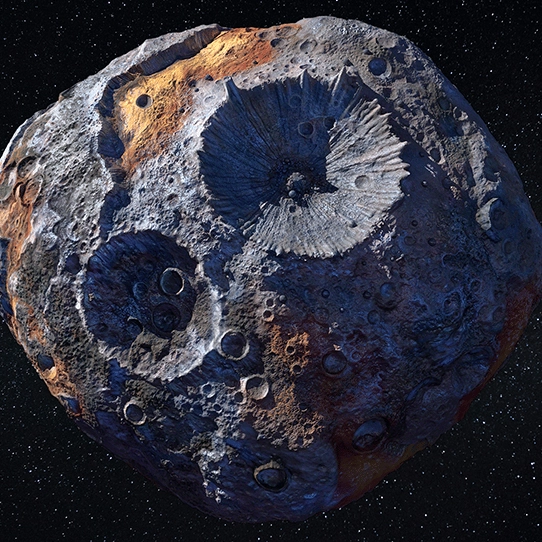
Biggest risk facing NASA as they try to capture asteroid that would give everyone on Earth $1,246,105,919 each


Many have got their hopes up after learning that an asteroid in NASA's sightline could give everyone on Earth $1,246,105,919 each - but the reality is perhaps more complicated than we previously thought.
16 Psyche is one of the largest and most recognizable asteroids in space right now, and that's why NASA has made it a primary target to reach with the help of a SpaceX Falcon Heavy rocket.
The 'Psyche spacecraft' launched in October 2023, and is currently scheduled to reach it's asteroid destination by July 2029.
Along the way it'll use the gravitational pull of Mars to propel itself towards 16 Psyche, and overall it'll end up traveling around 2.2 billion miles (3.5 billion kilometers).
Advert
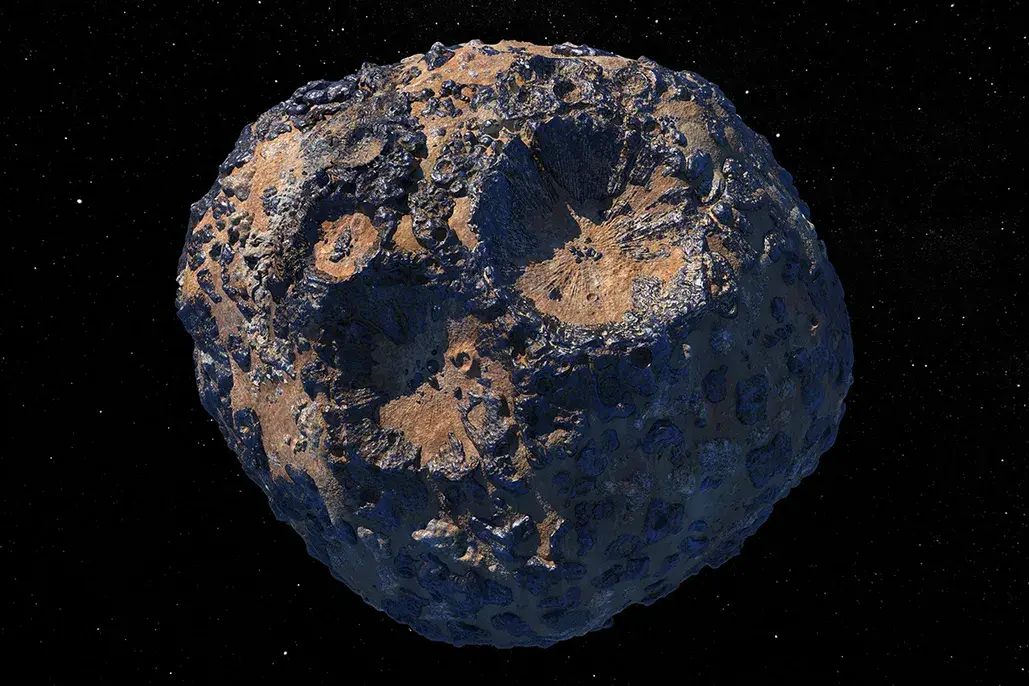
For scientists the primary function of this expedition is to uncover information about the formation of Earth, as 16 Psyche is believed to be a planetesimal, and could provide a breakthrough regarding the history of our planet and other similarly rocky or terrestrial spheres.
However, for the rest of us down on earth the real draw is the asteroid's value, as it's estimated appraisal is around $10,000,000,000,000,000,000 or 10 quintillion dollars, in simple terms. That's a lot of money!
If this was split equally between every single person on Earth then we'd all be landed with $1,246,105,919, which is quite the attractive proposal if I don't say so myself.
The reason behind this value is the copious amount of valuable metals found within the asteroid, as scientists have estimated that 30 to 60% of its construction is made up of gold, iron, nickel, and more.
With a diameter of 173 miles at its widest point, and 64,000 square miles of total surface area, you can start to understand why 16 Psyche is worth so much.
There might just be a catch to the proceedings though, making this more of a distant dream than the reality we're all hoping for.
As explained by Kevin Cannon, assistant professor of geology and geological engineering at Colorado School of Mines, in an interview with Live Science, the process of mining an asteroid like 16 Psyche would not only be "economically dubious" due to the extraordinary cost of the process, but it's not even close to being ready in the first place.
"There is no magic technology that we have to invent to mine asteroids," explains Cannon, "It's a matter of having the will to do so and putting the capital towards doing it."
One planetary physicist explained that technology for mining asteroids is currently sitting 'between and 3 and a five' on a 1 to 9 readiness scale proposed by NASA.
Even with the financial support, which NASA claims its lacking, it would still take around five years for a 'small-scale' effort to be produced.
There is also the threat of rust, which has also been reported by Live Science, as suggestions of hydration upon the asteroid have caused surface metal to rust, which will cause it to devalue on the market if mined.
On top of this, economists would surely have concerns over the viability of an economy - especially one stretching across the world - where everyone is suddenly given over a million dollars.
You don't need to be a genius with money to theorize how that would affect the price of things and the wider global economy, and would likely cause a crash far greater than anything we've seen before.
Maybe then it's a good thing that we won't be getting all that money, as painful as that is to say out loud.