Mark your diaries: Scientists have predicted when an asteroid could hit Earth with force of 22 atomic bombs


It's always good to be prepared for the apocalypse, and in this case, scientists have armed us with helpful information: the exact date an asteroid is predicted to smash into Earth with the force of 22 atomic bombs.
The asteroid - which has the rather cute name of 'Bennu' - passes by Earth every six years - although obviously, it doesn't always end in disaster.
Advert
Luckily, we don't have to be too concerned, as its predicted collision date is actually near the end of the 22nd century
And it might not even be a catastrophe, thanks to the work of scientists.
NASA has been working on plans to avert disaster by diverting Bennu's collision course - and their vital mission is reportedly in the "final leg".
Richard Burns, project manager for OSIRIS-REx at NASA’s Goddard Space Flight Center in Greenbelt, Maryland, said: "We are now in the final leg of this seven-year journey, and it feels very much like the last few miles of a marathon, with a confluence of emotions like pride and joy coexisting with a determined focus to complete the race well."
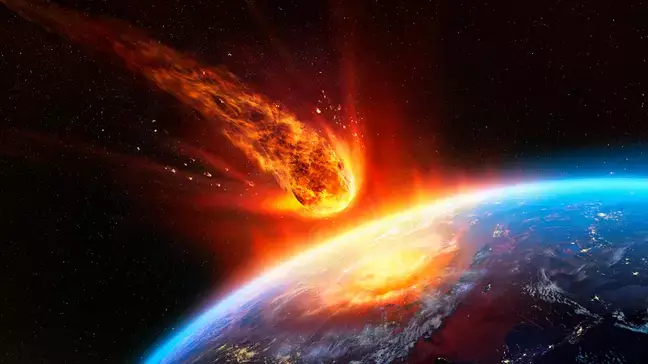
Diverting Bennu is no mean feat, as it's a bit of a monster - clocking in at around a third of a mile wide. For slightly terrifying context, that makes it around half the size of the asteroid that we think wiped out the dinosaurs. If it did crash into Earth, that means it would cause devastation 600 miles from the crash site - but we'd escape worldwide extinction.
If you did want to mark your diaries, NASA predicts Bennu will hit Earth on September 24, 2182 - but the space agency also said there was an "extremely small chance" of it actually happening.
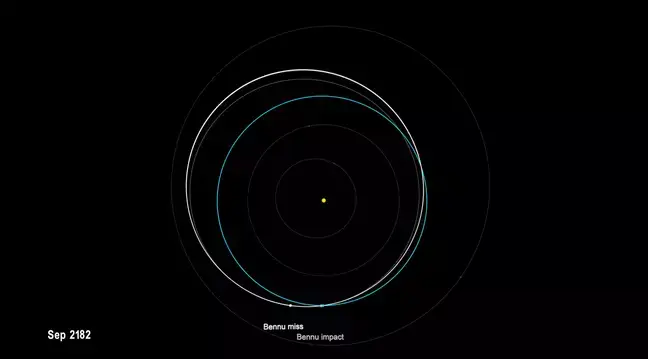
According to a paper shared by the OSIRIS-REx science team, there is a 1:2700 (0.037%) chance of this missile impacting Earth on September 24, 2182.
“Although it is difficult to determine the odds of this actually happening, new data from NASA’s OSIRIS-REx spacecraft have allowed scientists to better model how Bennu’s orbit will evolve over time, and to better calculate the probability of an impact,” NASA explains.
On September 25, 2135, Bennu will make a close flyby of Earth. Bennu’s location in 2182 will vary depending on how the 2135 flyby goes, according to NASA.
There is a one in 1,750 chance Bennu will hit earth by 2300.