uniladtech homepage
  • News
    • Tech News
    • AI
  • Gadgets
    • Apple
    • iPhone
  • Gaming
    • Playstation
    • Xbox
  • Science
    • News
    • Space
  • Streaming
    • Netflix
  • Vehicles
    • Car News
  • Social Media
    • WhatsApp
    • YouTube
  • Advertise
  • Terms
  • Privacy & Cookies
  • LADbible Group
  • LADbible
  • UNILAD
  • SPORTbible
  • GAMINGbible
  • Tyla
  • FOODbible
  • License Our Content
  • About Us & Contact
  • Jobs
  • Latest
  • Archive
  • Topics A-Z
  • Authors
Facebook
Instagram
X
TikTok
Snapchat
WhatsApp
Submit Your Content
Over 100 never-before-seen species discovered along deep sea mountain range
Home>Science>News
Published 12:51 23 Feb 2024 GMT

Over 100 never-before-seen species discovered along deep sea mountain range

The incredible discoveries include a strange bony fish and a spiky lobster.

Prudence Wade

Prudence Wade

google discoverFollow us on Google Discover
Featured Image Credit: Schmidt Ocean Institute
Science
World News

Advert

Advert

Advert

An underwater mountain range off the coast of Chile has offered up a veritable treasure trove of discoveries, including more than 100 entirely new species.

A series of recent expeditions took a far closer look at a mountain range deep underwater, some 1,800 miles long, called the Nazca and Salas y Gómez Ridge.

The Schmidt Ocean Institute expeditions used a robot to explore a selection of these underwater mountains at depths of 14,763 feet, and found incredible biodiversity.

International scientists may have discovered more than 100 new species living on seamounts off the coast of Chile. The recent expedition resulted in identifying deep-sea corals, glass sponges, sea urchins, amphipods & other species likely new to science.https://t.co/hrZt67MX73 pic.twitter.com/OYoLML4tHV

— Schmidt Ocean (@SchmidtOcean) February 22, 2024

Even more amazing, each mount apparently had a completely different ecosystem to the last, so the team found new species and inter-species relationships each time they looked.

The team was led by Dr Javier Sellanes, from the Universidad Católica del Norte, and he was unsurprisingly effusive about the discoveries: "We far exceeded our hopes on this expedition. You always expect to find new species in these remote and poorly explored areas, but the amount we found, especially for some groups like sponges, is mind-blowing".

Advert

While sponges might not sound that amazing, some of the footage and photos of the flora and fauna they found is absolutely breathtaking.

It encompasses fern-like coral formations that have fronds that almost look like leaves and an incredible number of urchins and spiny shells in different shapes and colors.

We’re here at #OSM24 where scientists & experts from 60 nations have gathered to help shape the future of ocean science — it is the UN Ocean Decade & we’re advancing the science we need for the ocean we want. Find @SchmidtOcean: https://t.co/NAPkkME0uC pic.twitter.com/VmbAPJ29ak

— Schmidt Ocean (@SchmidtOcean) February 21, 2024

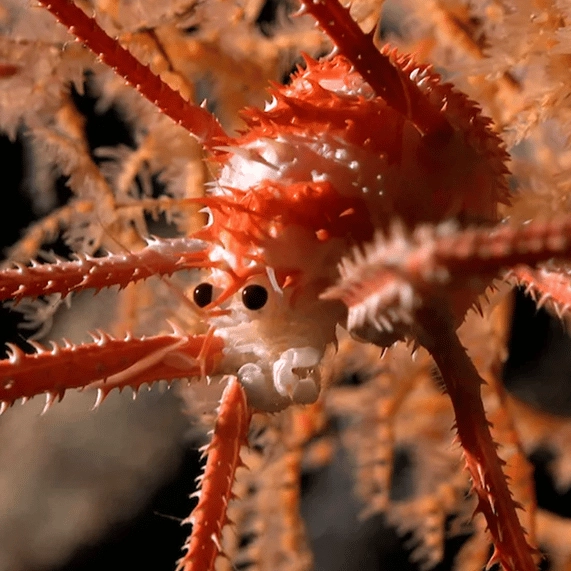
There are plenty of species that look pretty incredible, too, including an incredibly spiny almost spider-like lobster that the team found at 2,194 feet, and believes is a new species.

While some of the life observed were not new discoveries, they're nonetheless amazing to see, like a bright red Chaunax fish with a huge gaping mouth found down at 4,553 feet of depth.

One amazing photo shows this fish looking almost like it's clinging to a rock next to it, and its body shape has to be seen to be believed.

This series of finds won't be the end of the story - firstly, there's loads of testing to be done now to establish what is and isn't a new species, which can be quite complex.

Furthermore, the team of scientists hopes that this can be part of the wider conversation about conservation and protection. These mountains are in protected waters, but there's always room for more legislation and funding to help keep these marine environments safe from pollution.

Choose your content:

3 hours ago
4 hours ago
22 hours ago
a day ago
  • STEPHANE DE SAKUTIN / Contributor via Getty
    3 hours ago

    Scientists use 67-million-year-old DNA to grow world's first T-Rex leather bag, but no one wants it

    You could integrate the Late Cretaceous period into your summer wardrobe

    Science
  • Andrii Iemelyanenko / Getty
    4 hours ago

    Common $20 powder sitting in your kitchen can actually 'supercharge' human immune cells

    This could be vital to treating cancer and removing tumors

    Science
  • NASA/JPL-Caltech
    22 hours ago

    NOAA issues warning as 'Super El Niño' officially begins as hottest year on record approaches

    This could have a negative knock-on effect around the world

    Science
  • Vidmar Fernandes via Getty
    a day ago

    Scientists may have finally solved mystery of space’s strange 1.4-Hour radio signal

    The strange signal has been baffling astronomers since 2005

    Science
  • Horrifying 'zombie' spiders infected by never-before-seen fungus are taking over US homes
  • Never-before-seen footage shows world's most isolated tribe
  • Scientists uncover huge discovery of 'never seen before' part of human body
  • David Attenborough honored for 100th birthday with new species named after him