uniladtech homepage
  • News
    • Tech News
    • AI
  • Gadgets
    • Apple
    • iPhone
  • Gaming
    • Playstation
    • Xbox
  • Science
    • News
    • Space
  • Streaming
    • Netflix
  • Vehicles
    • Car News
  • Social Media
    • WhatsApp
    • YouTube
  • Advertise
  • Terms
  • Privacy & Cookies
  • LADbible Group
  • LADbible
  • UNILAD
  • SPORTbible
  • GAMINGbible
  • Tyla
  • FOODbible
  • License Our Content
  • About Us & Contact
  • Jobs
  • Latest
  • Archive
  • Topics A-Z
  • Authors
Facebook
Instagram
X
TikTok
Snapchat
WhatsApp
Submit Your Content
Chinese lab creates $300,000,000 'ghost detector' in revolutionary tech breakthrough

Home>Science>News
Published 08:31 20 Dec 2024 GMT

Chinese lab creates $300,000,000 'ghost detector' in revolutionary tech breakthrough

Scientists will soon be able to study ghost particles

Rikki Loftus

Rikki Loftus

google discoverFollow us on Google Discover
Featured Image Credit: ALFRED PASIEKA/SCIENCE PHOTO LIBRARY/JADE GAO/AFP via Getty Images
Science
China
News
Tech News
Space
History

Advert

Advert

Advert

A Chinese lab has created a $300 million ‘ghost detector’ in a revolutionary innovation.

The tech breakthrough could finally unlock the secrets of ‘the other side’ but it might not be what you’re thinking.

No, it won't involve a seance.

Instead, the giant detector has been designed to analyze mysterious ghost particles also known as neutrinos.

Advert
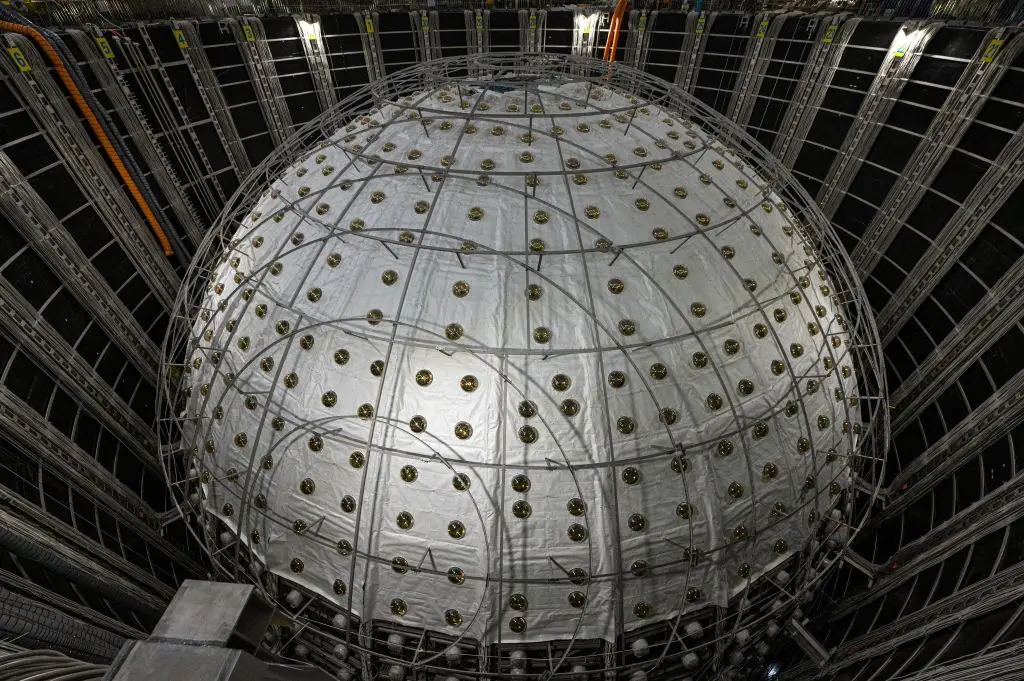
The building of the ghost detector is nearly complete (JADE GAO/AFP via Getty Images)

But what is a neutrino? Put simply, it is a subatomic particle that is very similar to an electron.

However, unlike an electron, a neutrino has no electrical charge and a very small mass.

Trillions of them move around our bodies every second but they’re mysterious because there are so few studies on neutrinos, despite them having been discovered nearly a century ago.

They’ve also been around since the dawn of time, according to scientists, who believe that the particle dates all the way back to the Big Bang.

It’s hoped that more research into the particles will assist scientists in their pursuit of finding out more about the creation of the universe.

Now, a huge $300 million project to build a detector is almost complete.

It has taken the team at the Jiangmen Underground Neutrino Observatory in Kaiping, southern China nearly a decade to finish the work, which involved building the detector at a place located 2,297 feet underneath a granite hill.
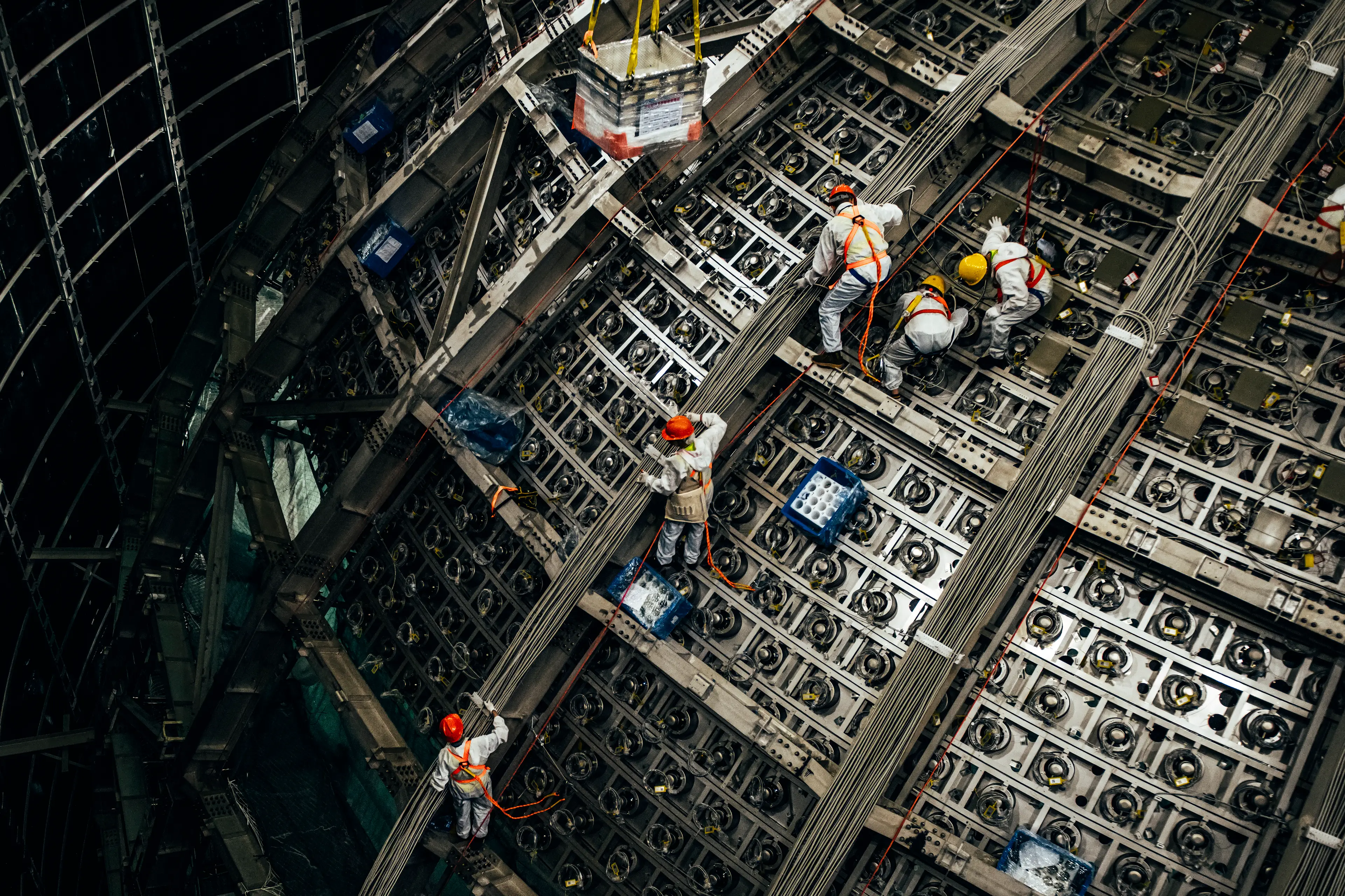
This detector could help us find out more about the creation of the universe (Qiu Xinsheng/VCG via Getty Images)

The firm isn’t the only one building this type of device, there are also competitors in the US and Japan but it looks like China has beaten them to it.

How does the ghost detector work?

The detector works by using a liquid that gives off light as neutrinos pass it by before submerging into purified water.

Cao Jun, who is involved in managing the detector, said: “It’s the least understood particle in our world.”

Jun went on to say: “That’s why we need to study it.”

According to Andre de Gouvea, who is a theoretical physicist at Northwestern University and is not involved with the project, this innovation will push the world’s tech to new limits.

de Gouvea said: “If they can pull that off, it would be amazing.”

The physicist went on to add: “The solution for how we measure these neutrinos is to build very, very big detectors.”

Wang Yifang, who is a chief scientist and a project manager involved in the building of this innovative tech, added: “In the end, we have a better understanding of the nature of physics.”

Choose your content:

19 hours ago
a day ago
  • Erik Simonsen / Getty
    19 hours ago

    How to see asteroid as big as five cruise ships visible from Earth this Saturday

    1997 NC1 was discovered in 1997, and will come the closest to Earth in 400 years

    Science
  • NASA Johnson
    a day ago

    Scientists sound the alarm over the environmental impact of NASA’s plan to deorbit the ISS

    Plans to dump the space station in the sea have been challenged by experts

    Science
  • Curtin University
    a day ago

    An asteroid slammed into Earth 3,000,000,000 years ago and we finally know where it hit

    The North Pole Dome impact structure is nowhere near as cold as its name would suggest

    Science
  •  NASA Johnson
    a day ago

    Experts expose a ‘troubling’ legal loophole in NASA's plan to dump the ISS in the Pacific

    The isolated Point Nemo is already known as a 'spacecraft cemetery'

    Science
  • Scientists witness the birth of a solar system for the first time in history using revolutionary tech
  • Ex-FBI agent claims 'voice-to-skull tech' could be behind string of missing scientists
  • China creates revolutionary brain chip that is 'better' than Elon Musk's Neuralink
  • Rare photos of 'ghost dog' finally captured as scientists make phenomenal discovery