Featured Image Credit: ABC News
The human body can contain some weird and wonderful things, like the man who found a two-inch spruce tree growing in his lungs, or one who found a living fly larva in his eyeball.
Up there with teratomas, which are tissues that can contain hair, bones, and teeth, stone babies are another terrifying natural occurrence.
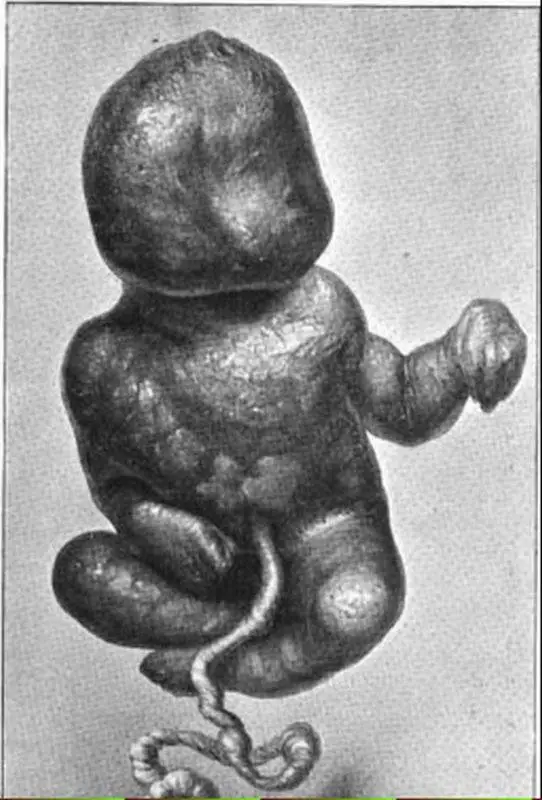
Known better as lithopedion, stone babies are a rare health phenomenon caused when a fetus dies during an abdominal pregnancy.
With it too large to be reabsorbed into the body, the fetus calcifies inside you as part of a foreign body reaction.
Advert
The pregnancy usually fails due to a lack of a blood supply, but there's no way for it to be expelled from the body.
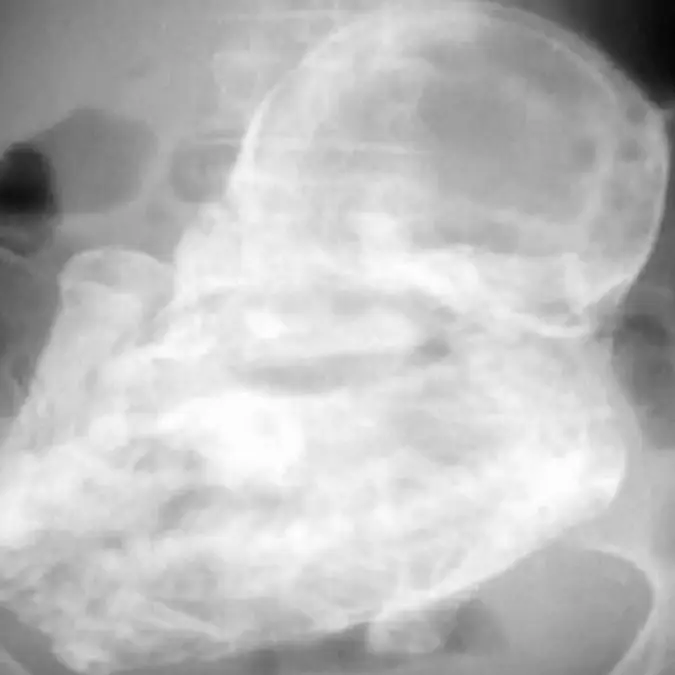
Back in 2013, an elderly Colombian woman went to the hospital while complaining of pains. Doctors were shocked to find a lithopedion inside her, but even more harrowing was the fact that she'd been carrying it for 40 years.
ABC News reports how she'd been lugging around the four-pound stone baby for four decades, only discovering it when doctors ordered an X-ray. Dr. Kim Garcsi directed the ob/gyn clerkship program at University Hospitals Case Medical Center at the time in Cleveland, reiterating just how rare the condition is. According to Garcsi, lithopedions have only been recorded around 300 times in medical literature.
Despite the grim nature of the idea, Garsci says the process is an important part of keeping the body healthy.
She explained: "When you get old cartilage in the knee, it calcifies.
"Most of the time, people find these and [sometimes] even after they're found and don't do anything about it because they're totally asymptomatic."
The rate of abdominal pregnancy is about 1 in every 10,000, although modern medicine can usually detect issues that would lead to a lithopedion long before it forms. As the unnamed woman would've been carrying the baby since the '70s, things have come a long way since then.
Stone babies are a fascinating phenomenon that we've known about for centuries. They were first mentioned by the Spanish Muslim physician Abū al-Qāsim in the 10th century, and by the mid-18th century, cases had been reported in hares, sheep, and humans in France and Germany.
An archeological investigation of a sinkhole in Texas has also found a lithopedion dating back to 1100 BCE, while the most modern case was reported from a Kenyan woman in 2020.
When the story resurfaced on Reddit, people were equally shocked and terrified by the tale of the stone baby.
One sympathetic onlooker wrote: "Poor woman. I can't imagine how confused and sad that makes a person emotionally."
Another added: "No one took her seriously for 40 YEARS? Not a single radiographic investigation?! Talk about failing her!"
A third concluded: "Wake up babe, a new existential womanly fear just dropped."