
uniladtech homepage
  • News
    • Tech News
    • AI
  • Gadgets
    • Apple
    • iPhone
  • Gaming
    • Playstation
    • Xbox
  • Science
    • News
    • Space
  • Streaming
    • Netflix
  • Vehicles
    • Car News
  • Social Media
    • WhatsApp
    • YouTube
  • Advertise
  • Terms
  • Privacy & Cookies
  • LADbible Group
  • LADbible
  • UNILAD
  • SPORTbible
  • GAMINGbible
  • Tyla
  • FOODbible
  • License Our Content
  • About Us & Contact
  • Jobs
  • Latest
  • Archive
  • Topics A-Z
  • Authors
Facebook
Instagram
X
TikTok
Snapchat
WhatsApp
Submit Your Content
Expert explains the warning signs behind eye ‘floaters’ and what to do if you see them
Home>Science
Published 15:19 11 May 2026 GMT+1

Expert explains the warning signs behind eye ‘floaters’ and what to do if you see them

It's worth knowing the signs before it's too late

Rebekah Jordan

Rebekah Jordan

google discoverFollow us on Google Discover
Featured Image Credit: RUSLANAS BARANAUSKAS/SCIENCE PHOTO LIBRARY / Getty
Health
Science

Advert

Advert

Advert

There are plenty of minor health peculiarities we tend to brush off and get on with our day, whether it's a twinge here or an odd sensation there.

But if you have ever noticed strange shapes drifting across your vision, it may be more concerning than you think.

Those shapes, called 'floaters' are often harmless, but knowing when to act on them could make a huge difference to your long-term eye health.

What are 'floaters'?

Floaters are typically caused by a process called posterior vitreous detachment (PVD). It's a largely harmless change that happens as the gel-like substance inside the eye alters in consistency.

Floaters are caused by a process called posterior vitreous detachment (RUSLANAS BARANAUSKAS/SCIENCE PHOTO LIBRARY/Getty)

Advert

As Dr Daniel Polya, an expert from the Royal Australian and New Zealand College of Ophthalmologists, puts it to Daily Mail Australia: “It's the condensation of the collagen fibres. Large molecules of collagen clog together and cast shadows on your retina which you perceive as eye floaters.”

In rarer and more serious cases, floaters can also be associated with retinal detachment, which if left untreated, can lead to permanent vision loss.

It is also worth noting that floaters and flashes can sometimes occur for no apparent reason, which is why knowing when to seek advice matters.

What are the symptoms of floaters?

According to the NHS, floaters can appear in a variety of forms, including: small dark dots, squiggly lines, rings, and cobweb-like shapes drifting across your vision.

Flashes can accompany floaters in some cases and typically appear as sudden bursts of light.
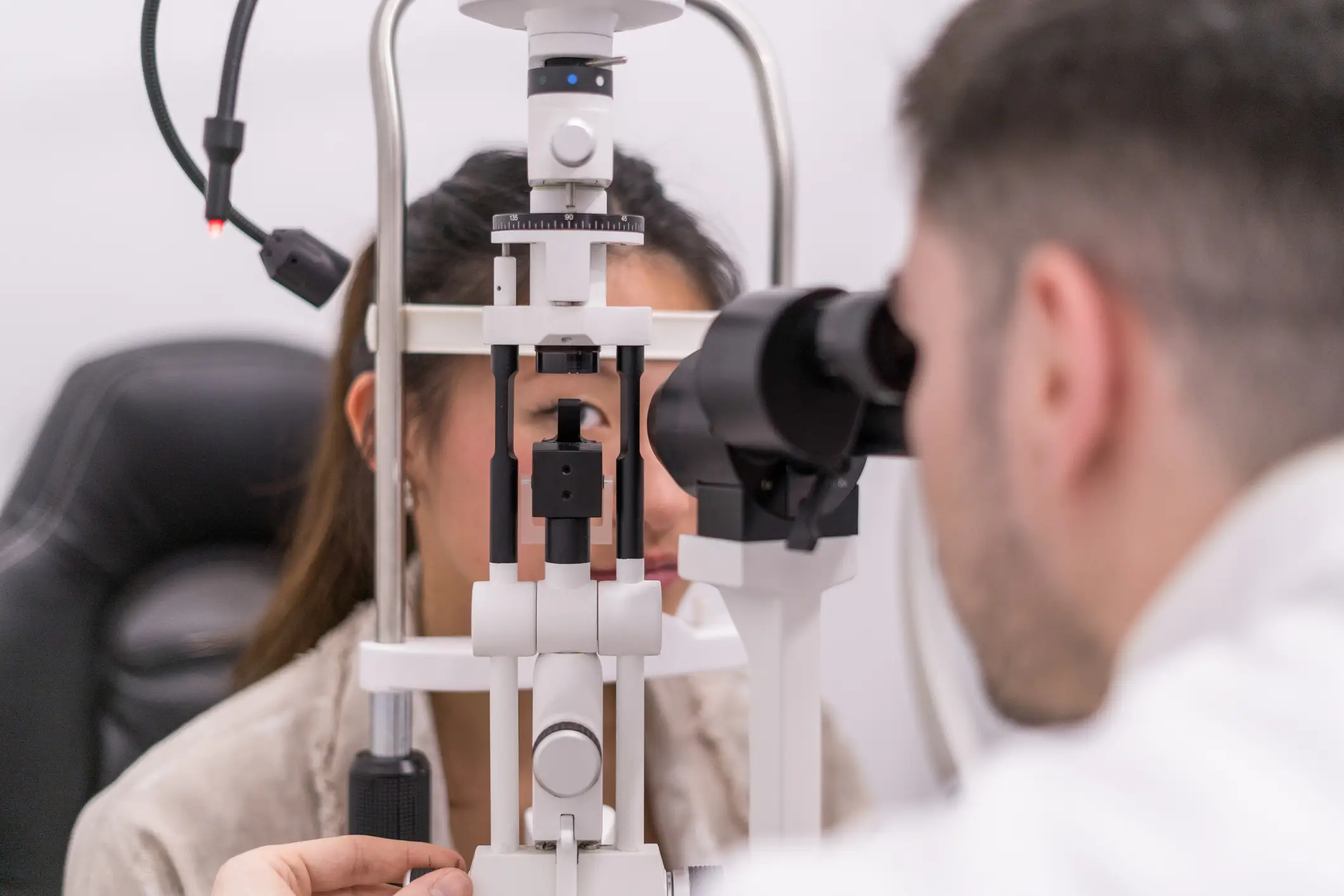
Dr Polya is clear that anyone who sees a floater for the first time should 'see an optician' (Raul Ortin/Getty)

When should you see a doctor about floaters?

Dr Polya is clear that anyone who sees a floater for the first time should 'see an optician' as PVD does still carry a degree of risk.

“For those that get PVD, there's a five percent chance it's developing a tear in the retina, and if a tear does occur, there's a 50 percent chance of retinal detachment,” the eye expert explained.

“What's really disappointing is when someone will come in with retinal detachment from a posterior vitreous detachment that hasn’t been examined earlier.”

That said, if floaters are not new, are not getting worse, and your vision is unaffected, the NHS advises there is generally little cause for concern.

Can floaters be treated?

If a retinal tear is identified, laser surgery can be used to seal it and prevent further damage, but timing is everything. While laser surgery can treat a retinal tear, it's crucial to catch the issue early to prevent further damage.

Dr Polya added: “PVD is common and not that disappointing to see, whereas retinal detachment is disappointing to see in a patient who could have had an earlier exam when they first got floaters.”

Choose your content:

an hour ago
2 hours ago
4 hours ago
22 hours ago
  • Kevin Carter / Contributor via Getty
    an hour ago

    NASA detects unusual activity brewing in ocean waters off the east coast

    Satellite images picked up strange coloured plumes

    Science
  • Francois LOCHON/Gamma-Rapho via Getty Images
    2 hours ago

    Hantavirus fears hit one of world's most remote islands with population of just 35

    A passenger from the MV Hondius cruise ship visited the remote island

    Science
  • Varlay / Getty
    4 hours ago

    Scientists are developing daily weight loss pill that means you're seven-times more likely to keep weight off

    It serves as an alternative to popular injections like Ozempic and Wegovy

    Science
  • Catherine Falls Commercial / Getty
    22 hours ago

    Scientist finally puts an end to debate over baths or showers being more hygienic

    This might change how you wash yourself

    Science
  • Doctor reveals what your body could be telling you if you have hairy toes
  • Nuclear expert explains exactly what would happen to you if you saw an atomic bomb explode
  • New research uncovers warning signs of early death you should never ignore
  • Expert reveals six warning signs of sleep apnea that you should never ignore